Establishment of Cheetahs in India
Through the efforts of Hon'ble Prime Minister Shri Narendra Modi, cheetahs that had gone extinct
in India in 1952 were reintroduced and established at Kuno National Park on 17 September 2022.
Timeline
- September 20228 cheetahs were brought to Kuno National Park from Namibia.
- February 202312 cheetahs were brought to Kuno from South Africa.
- March 2023The first cheetah cubs were born in India.
- October 2023Cheetahs were released in a phased manner into large enclosed natural areas and then into the open natural environment.
- April 20253 cheetahs were released at Gandhi Sagar Sanctuary, developed as the second site after Kuno.
- January 2026The process was carried out to bring 9 cheetahs from Botswana.
- March 2023 – March 2026In the last three years, a total of 45 cheetah cubs have been born in India, of which 33 are developing healthily.
Currently, combining 50 cheetahs (adults and cubs) in Kuno and 3 cheetahs (adults) in
Gandhi Sagar, the total number of cheetahs in India has increased to 53.
History of Cheetah Establishment in Veerangana Durgavati Tiger Reserve
- 2009-10In the assessment of potential sites for the cheetah establishment project, Nauradehi and Kuno Wildlife Sanctuaries in Madhya Pradesh and the Shahgarh area in Rajasthan were found to be the most suitable sites.
- 2013The cheetah establishment project was suspended for some time due to a petition filed in the Hon'ble Supreme Court.
- 2020After resolving all obstacles, the cheetah project was restarted as per the directions of the Hon'ble Supreme Court. Kuno was selected on the basis that its suitable park area had been notified, it had no human population within its boundary, and the surrounding forest areas had comparatively less human pressure.
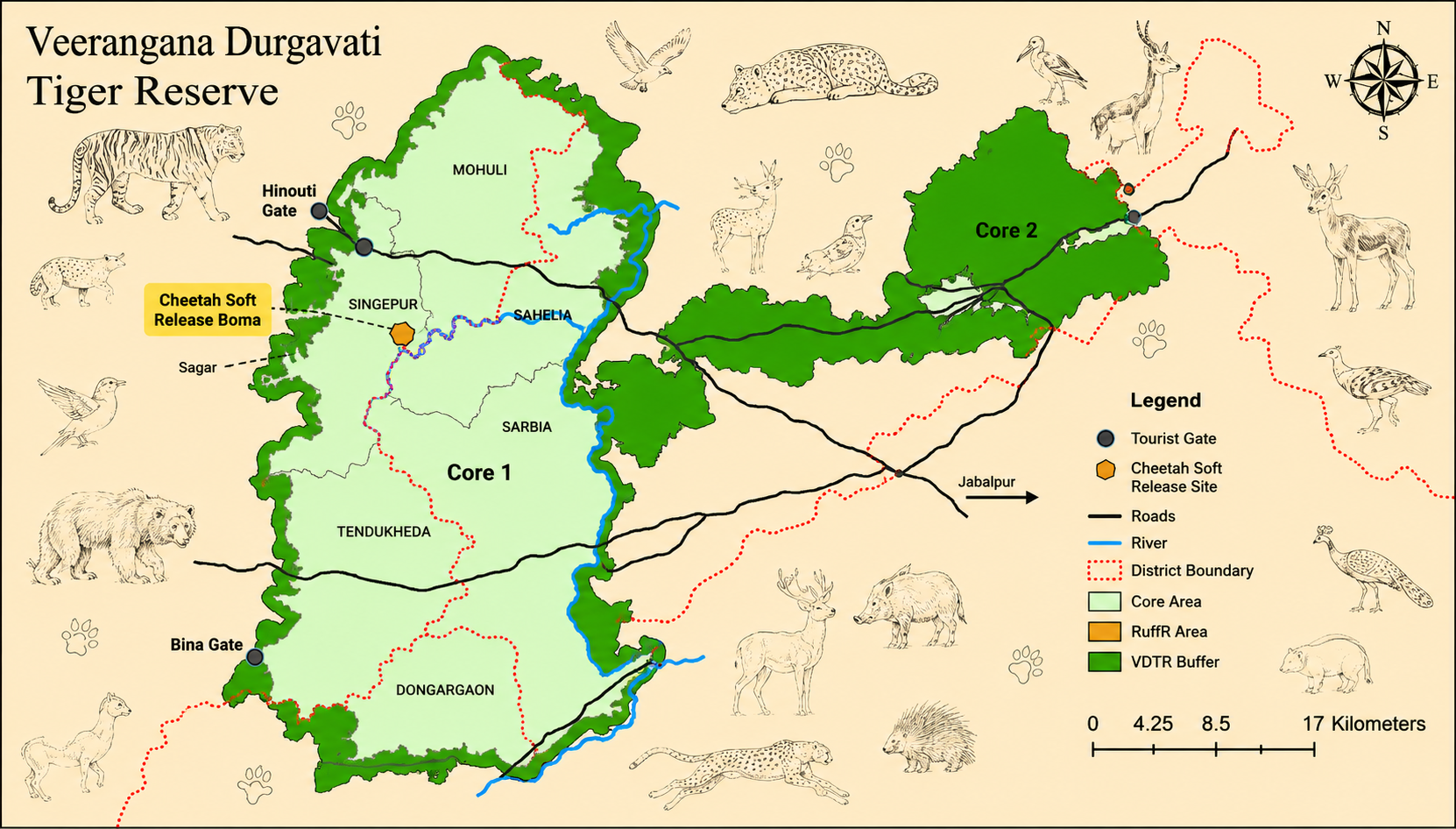
- September 2023Nauradehi and Rani Durgavati Sanctuaries were merged and officially notified as Veerangana Durgavati Tiger Reserve, becoming the 54th tiger reserve of the country and the 7th tiger reserve of Madhya Pradesh.
- February 2025After becoming a tiger reserve, due to the accelerated relocation of villages within it, its core area being almost double that of Kuno, the availability of abundant natural prey on relocation and agriculture-free land, and its population being suitable for cheetahs, VDTR was granted permission to be developed as the third habitat for cheetahs after Kuno and Gandhi Sagar.
- May 2026The selection of sites for building cheetah enclosures in VDTR and the work on the Standard Operating Procedure (SOP) for security were completed.
After the establishment of cheetahs, this will be the world's first reserve of its kind
where big cats such as tigers, leopards, and cheetahs will officially co-exist together.


 English